
Who Wrote This?

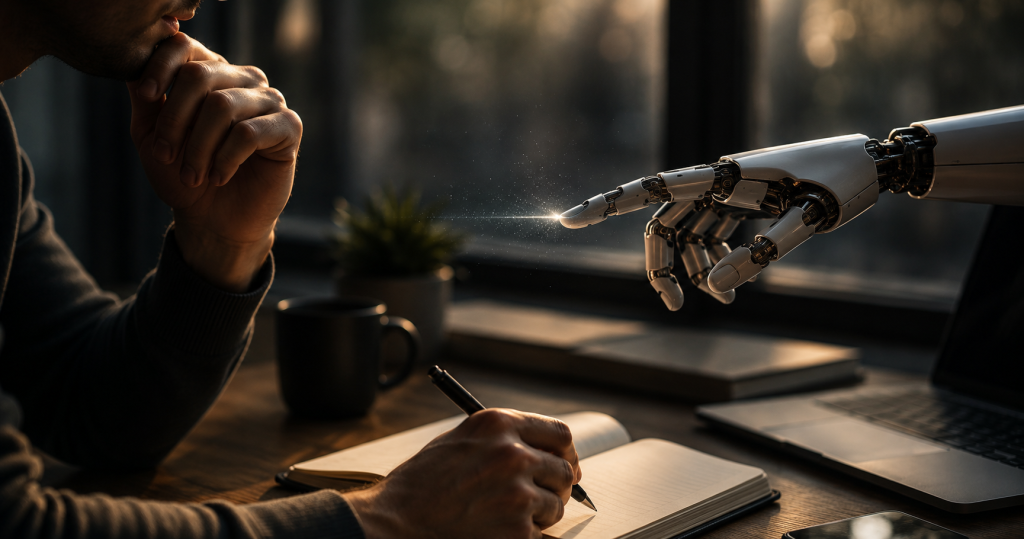
Something quietly important happened in AI this week.
Anthropic announced that future Claude models will place an invisible watermark in the text they generate.
You won’t see it.
The words will look the same. Copying and pasting the text won’t necessarily remove it. But underneath the writing will be a statistical signal designed to help determine whether Claude participated in creating it.
The immediate reason is practical: transparency requirements under Europe’s AI rules.
But there’s a much more interesting question hiding underneath.
The Bigger Question
When a human thinks with AI, who is the author?
For most of history, authorship seemed relatively simple.
Someone sat down and wrote something.
Of course, it was never quite that simple. Writers had editors. Scientists had colleagues. Executives had assistants. Politicians had speechwriters. Musicians borrowed melodies. Every idea was influenced by thousands of ideas that came before it.
But we still liked putting one person’s name at the top.
Then AI arrived.
Suppose you have an idea while walking to work.
You explain it badly to an AI.
The AI helps you organize it.
You disagree with half of what it writes.
You rewrite the argument.
It suggests an analogy you hadn’t considered.
You change the analogy.
It cleans up your grammar.
You delete two paragraphs.
You add something deeply personal that the AI could never have known.
Eventually you publish it.
Who wrote it?
You?
The AI?
Both?
And perhaps there’s an even more uncomfortable question:
Does it matter?
We tend to think about AI assistance as binary.
Human-made or AI-made.
Real or artificial.
Original or generated.
But increasingly, creation doesn’t work that way.
There is a spectrum.
A person might ask AI to write an entire article and publish it without reading it.
Another person might spend three days developing an argument and use AI to fix six grammatical errors.
Technically, both pieces involved AI.
But calling them equally “AI-generated” tells us almost nothing about what actually happened.
Maybe we’re asking the wrong question.
Instead of asking:
“Did AI make this?”
Perhaps we should ask:
“Where was the human judgment?”
Who decided what was worth saying?
Who questioned the assumptions?
Who rejected the bad ideas?
Who took responsibility for the final result?
That last question may matter most.
Because authorship isn’t only about producing words.
It’s about owning them.
If you publish something under your name, perhaps the important question isn’t whether AI helped you write it.
Perhaps the important question is whether you’re willing to stand behind it.
AI can suggest the sentence.
But it cannot take responsibility for what that sentence does in the world.
You can.
And maybe that’s where human authorship increasingly lives.
Not in typing every word.
But in judgment.
Selection.
Taste.
Intent.
Responsibility.
The tools we use to create are becoming invisible.
Our responsibility for what we create shouldn’t become invisible with them.
This Week’s Practice
Take something you created with AI recently.
Look at the finished result and ask yourself:
Where am I in this?
Find the sentence, decision, idea, or judgment that could only have come from you.
If you can’t find one, change something.
Make it yours.
For the Community
When does AI assistance become AI authorship?
Would knowing that something was written with AI change how seriously you take it?
And what matters more to you: who wrote something, or whether what they wrote is worth reading?
The reflection ends here.
The conversation begins with you.